Histuurisia rakenuksia Kotiseututalola
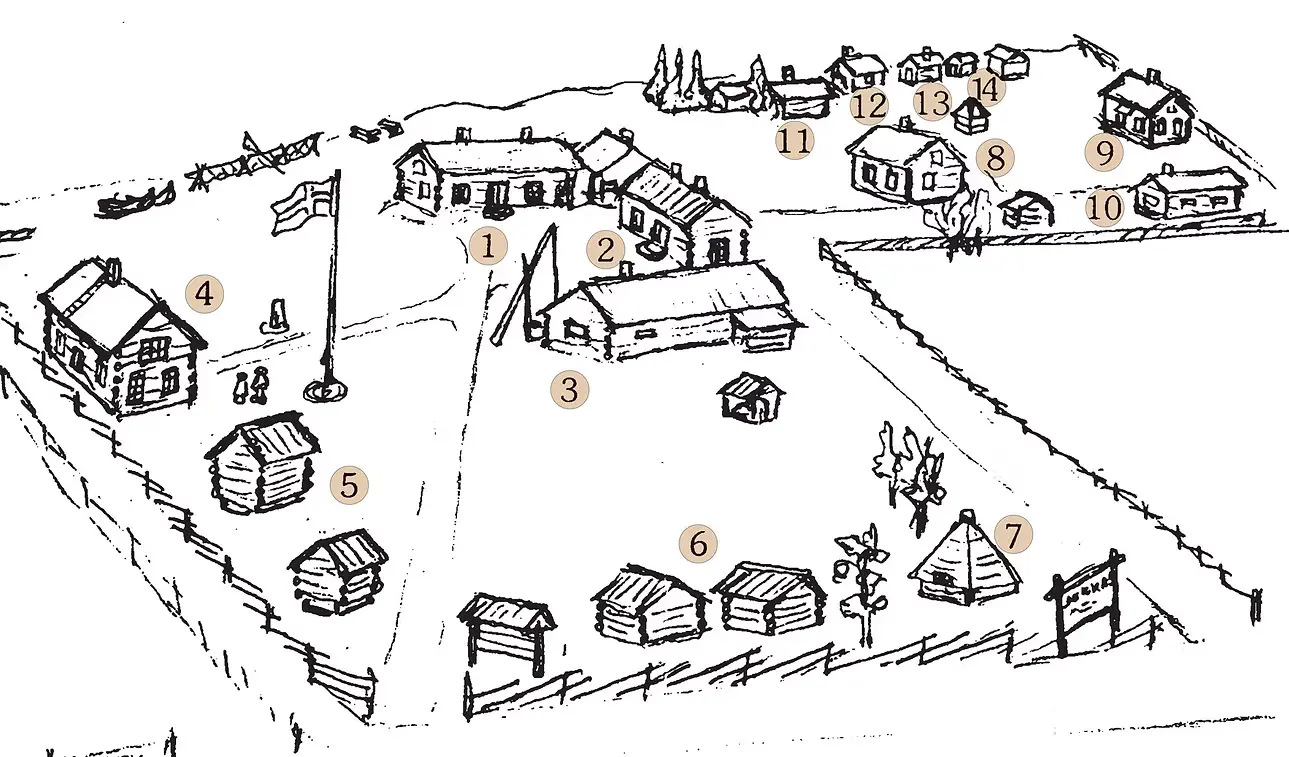
Pappilagården / The Pappila Farm
Pappila means Vicarage in Meänkieli/Finnish.
Formerly the Vicarage was located on this estate, which burned down in 1836.
A new vicarage was built in Vittangi.
Ragnhild Persdotter Huuva marries Olof Hansson and takes over the estate.
The farm was built in the 1850s and they chose to take the name Pappila as their last name.
Ragnhild & Olof Pappila had 10 children.
It is said that the upper part of the house may have come from the Vuolusjoki estuary, where it functioned as a warehouse at the blast furnace during the 18th century when the mine in Sjangeli was in operation.
The Pappila Farm was inhabited until the 1930s.
After that, the Jukkasjärvi Local History Association buys the farm.
The cowshed
This is where the animals, cows, sheep and horses were kept.
A phenomenon that occurred in Tornedalen was that farms had two cowsheds. One used during the winter and one during the summer.
The winter barn was usually a timber building with a fairly low ceiling inside.
The summer cowshed could be located further away from the farm.
Granary
This is where food such as grain, flour, dried meat and fish were stored.
The posts in each corner support the timber and prevent small animals from getting in.
Barn
There were different models of barns depending on what they were used for. The feed barns out on the marshes were more sparsely built, so that the air could circulate.
There the hay was left to dry and was brought home when the marshes froze.
Hay was also stored in the barns on the farms. These barns were built in a technique where the timber logs were nested inside each other.
Lantalainen
This beautiful log house, “The Lundströms’ Farm” comes from Harads. Probably built in 1897.
The Lundström family, Nils-Petter and his wife Emma Wilhelmina with their 13 children lived in this house.
During the 1990s, the Jukkasjärvi Local History Association bought the log house and it was set up at the Local History Museum/The old Homestead, in Jukkasjärvi.
School
From school in 1768 to guesthouse/restaurant.
This log house was built in 1768 after a decision by the Directorate for the region, which governed regional matters, including educational issues and school facilities.
The house was used as a school between 1768-1820.
It also housed the residence for the school priest (koulupappi) and a chamber (lastenkamari) for the 6 children who were boarded there.
The school was closed in 1820. The state sold the house to the churchwarden Hans Andersson Spett. The Spett family owned the house from 1820 until 1948 and it was used as an inn towards the end of their time on the farm.
In 1948, the Jukkasjärvi Local History Association acquired the house and it was moved to its current location to be used for serving food.
Inn
At the beginning of the 20th century, a new inn was built in Jukkasjärvi. The Pappila sisters, Brita-Maria & Sofia Vilhelmina served reindeer meat, marrow bones, broth, whitefish, processed sour milk and rieska, which is a kind of unleavened flatbread. Frequent guests included Hjalmar Lundbohm and his party, who were driven by horse & buggy from Kiruna. The Pappila sisters were innkeepers until 1930.
The outhouse/dry toilet or the big financiers privy
1863-1896, members of the boards of the mining companies AGM, Aktiebolaget Gellivare Malmfält and LKAB, Luossavaara Kirunavaara Aktiebolag, carried out an expedition along the railway line between Malmberget and Victoriahawn (after 1902 named Narvik).
The group also had venture capitalists and members of parliament with them. The background was to influence the Swedish parliament to vote to award both mining companies a concession to complete the railway to the ice-free Norwegian coast.
The expedition traveled from Victoriahawn/Narvik, via Rombak up to Katterat. From there, over the border to Sweden, across the vast Torneträsk/the Torne Lake, along the Torneäv/the Torne River, to the village of Kurravaara.
They continued to Luossajärvi/the lake of Luossa and further on to Malmberget, and from there by train to Luleå.
In Kurravaara the Torneus family lived, Vuolevi (Olof), his wife Anna-Kajsa and children.
On their farm, they ran an inn for STF, the Swedish Tourist Association. They received the financiers as their guests and for this special occasion, Vuolevi built a particularly fine wooden outhouse.
Later on, the daughter Anna-Lisa marries Sami school teacher Erik-Anders Henriksson in Jukkasjärvi, and eventually both the manor house and outhouse are moved to Jukkasjärvi.
The outhouse is then used as a net shed on the banks of the Torne River by the Henriksson family for several generations.
In the late 1970s, the Jukkasjärvi Local History Association receives the shed, the old outhouse, in exchange for a newly built one.
So today the “famous outhouse”, the big financiers privy, stands at The old Homestead/the Local History Association in Jukkasjärvi, continuously used as a net shed at this location.
Henttagården / The Hentta Farm
One of the oldest buildings in the village. The earliest known owner is Henrik Johansson, 1863-1912.
Later it becomes Amanda Pappila’s log house, 1920-1995 and was located at Kyrkstugvägen.
In 1995 it was moved to the location of the Local History Association in Jukkasjärvi/The old Homestead.